


the indian city of bikaner host an annual camel festival in january. the designs are the results of trimming and dying the camel hair. photos steve hoge and osakabe yasuo

Cerebellar Purkinje neurons, 2003. This photomicrograph shows a portion of the cerebellum in which only one type of neuron — its Purkinje cells — has been illuminated by a genetically encoded fluorescent protein; meanwhile, other classes of neighboring neurons that would have clouded the view have been left invisible.
Credit: Aric Agmon
Portraits of the Mind: Visualizing the Brain From Antiquity to the 21st Century,”
Mirror City Timelapse by Michael Shainblum

Lauren Clay

Source: http://isa.gg/


Source: http://le-vicieux.tumblr.com

Iceberg, St. John’s, North Atlantic. The bluish streaks in some Icebergs are caused by the the refreezing of meltwater which fills crevasses formed in the glacier(that creates the Iceberg. In other cases, the crevasses or holes (full of air) turn a deep blue.


revolving.gif + birdseye.gif
Source: http://gnumblr.tumblr.com
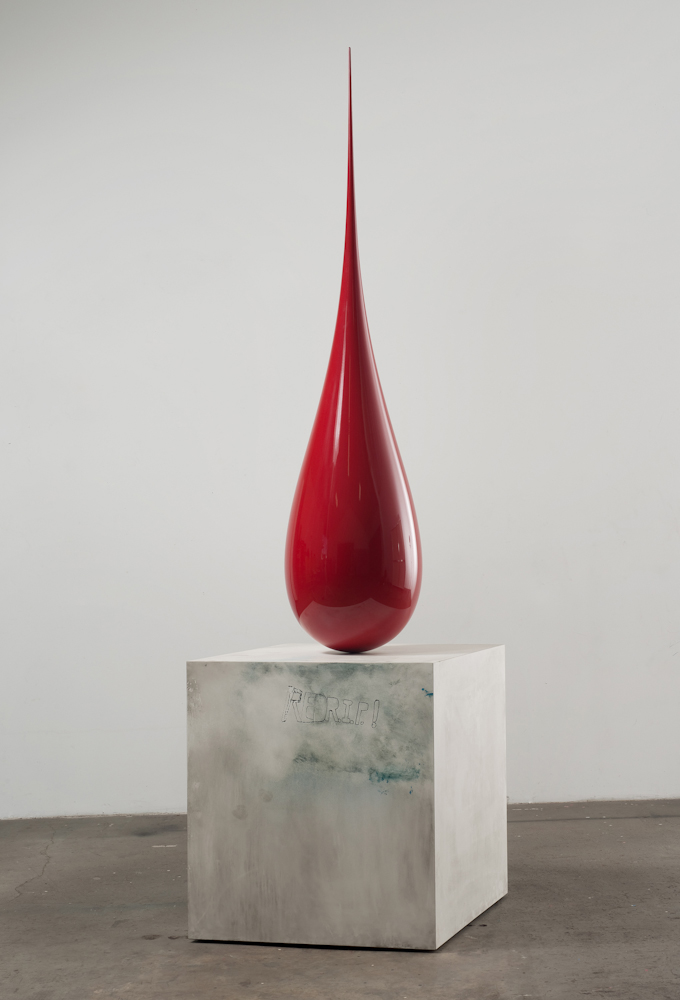

Drips by Sterling Ruby
Al Seckel, a cognitive neuroscientist and expert on illusions, created this “Levitating Water” installation, in which multiple streams of water appear as a series of levitating droplets thanks to a strobing light. The well-timed strobe lighting tricks the brain into seeing many different falling droplets as the same, nearly stationary droplet. The effect is similar to the one created by vibrating a stream of falling water. (Video credit: wunhanglo)
Most jellyfish swim through the water by periodically contracting their elastic bells. This shoots a jet out behind them propelling them forwards (albeit slowly). Here the affect on the surrounding water is shown through dye placed in front. Vorticity is shed into the fluid by the jellyfish’s motion which can be seen brilliantly in this video as the vortex ring coming off of the jelly fish body.
This video shows a multi-layered droplet, in which several droplets are formed one inside the other as an initial drop falls through a layer of oil sitting atop another liquid. When the drop falls, its potential energy gets transformed into interface energy, creating a fascinating interplay of surface tension, deformation, and miscibility between the fluids. Such self-contained multi-layered droplets, similar to multiple emulsions, could be helpful in pharmaceutical development. (Video credit: E. Lorenceau and S. Dorbolo 2004)

Side view of the pineapple shaped cavity created by a non-axisymmetric disk with 20 petals. (via Devaraj van der Meer - Research: Fluids)
See related video:
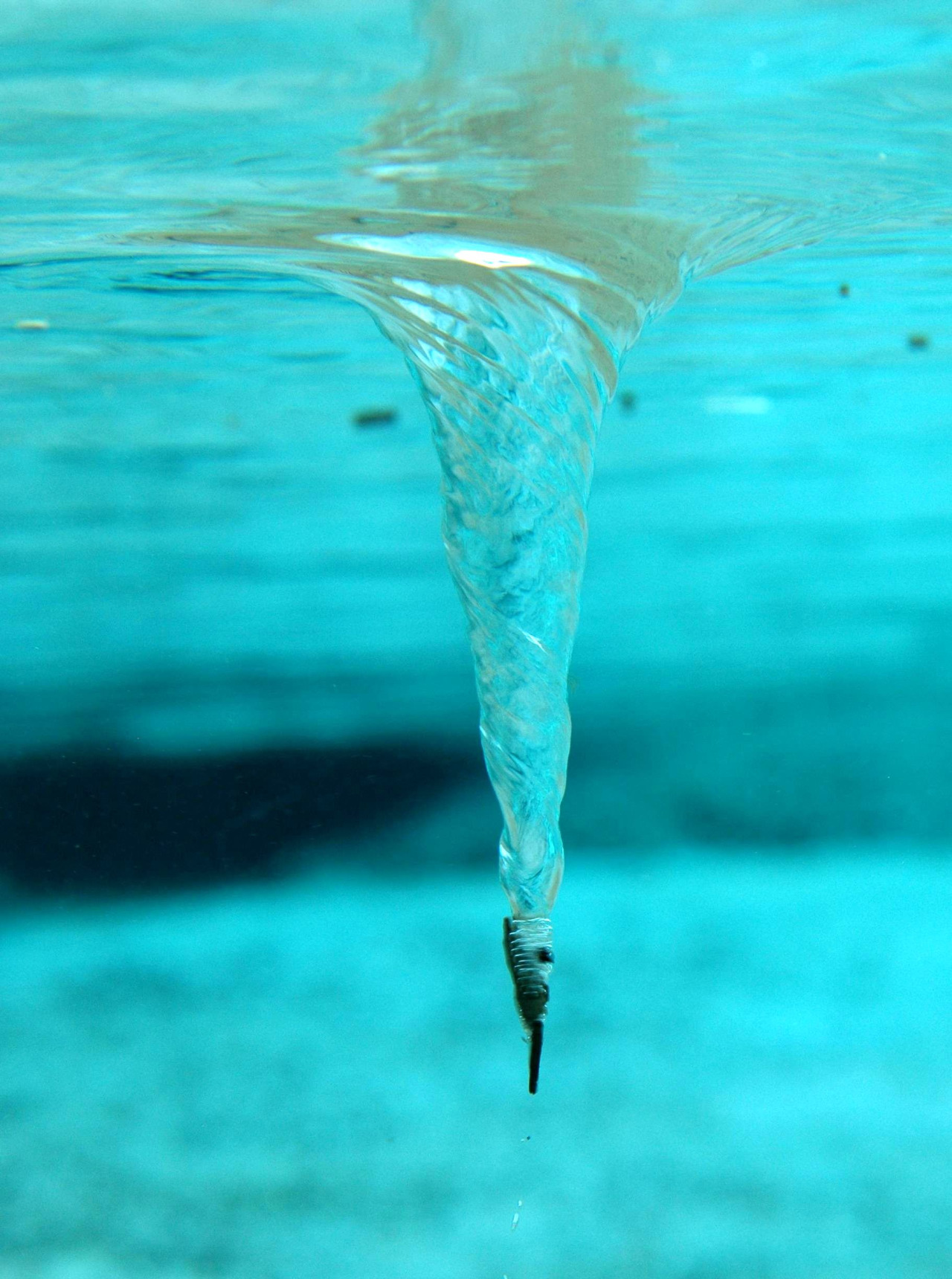
A few weeks ago I posted this great example of a water vortex in the form of a fountain. Here is another example from closer to home - from within a bath. As the water gets sucked out of the drain more water moves in to replace it. This water moves closer to the center and, in a simplified sense, has to move faster to conserve angular momentum. The same sorts of physics are involved in tornado creation although it is still unclear exactly how they form. Check out this artificial tornado from FYFD if you haven’t seen it already.
Credit:Dr. Rainer Kurz
A double emulsion inside a double emulsion: These concentric quadrupole emulsions, a drop inside of a drop inside of a drop inside of a drop, are very challenging to produce. Furthermore, to controllably generate a large number of them with all the same dimensions is impossible with conventional techniques. Here, using a new single step emulsification technique with a glass microfluidic device, layered fluids are controllably mass produced. The walls of the device are surface treated with silanes to control the wetting properties of the fluids so that five immiscible fluids converge to the same location in the device. Using appropriate flow velocities, fluids are sheared with respect to each other for drop formation. (Video Credit: Shin-Hyun Kim )


The immiscibility of oil and water creates a multitude of bubbles of all sizes. A lack of miscibility occurs when the forces between like molecules are very strong for two liquids—essentially the oil molecules and the water molecules are so much more strongly attracted to themselves than they are to one another that they cannot mix. Surface tension—another expression of molecular forces—pulls the oil into droplets that float in the water and refract the light in such lovely ways. (Photo credit: Vendula Adriana Kaprálová Hauznerová; via thinxblog)
Source: http://500px.com/AdrianaKH