Rayne: Mind blowing experiments with sound!
grönlund-nisunen - wave of matter
cool.
Harry Bertoia’s Sound Sculptures
Harry Bertoia began his career as a furniture designer for clients like Charles and Ray Eames and Knoll. His chairs sold so well that he turned to making sculpture full time, using similar materials to his furniture: metal sheets, wires, and rods. These sound sculptures were aesthetically minimal, but fulfilled a function beyond the visual. They were meant to be played as instruments, with the characteristic grids of rods swaying, colliding with each other and chiming, as would happen in the piece shown above. Some outdoor pieces were made to be triggered by the wind.

Tonkin Liu
Singing Ringing Tree
Wind powered sound sculpture, steel,
Lancashire, England
2006
Cycloïd-E, a sound sculpture by Andre and Michel Decosterd
To start off, a desire to approach mechanisms that produce visible undulatory movements and to set them against the development of sound waves. A pendulum. And if this pendulum was made up of horizontally articulated segments, if a motor replaced the gravitational effect? The segments of the pendulum become metallic tubes equipped with sound sources and with measuring instruments capable of making them resonate according to their rotations. A succession of unexpected movements becomes apparent. The equilibrium in the energy exchanges between the segments is almost perfect; the trajectories are surprisingly right and natural. We’re faced with Harmony. Through its fascinating and hypnotic dance, Cycloïd-ε delineates the space of sound orbits and creates a unique kinetic and polyphonic work, in the likeness of the «Cosmic ballet» to which the physicist Johannes Kepler refers to in his «Music of spheres» in 1619.
Zimoun : Sound Sculptures & Installations, Sound Architectures
Im awestruck. This is amazing and simple.


‘Ice’ - A sculpture representing the atomic structure of ice in porcelain and glass by Alexandra Carr
Further works found here…
Photographs by Stuart Beesley


paper marbling caterinasforzasfill a tray with water. blow, fan, stir, dab, and drag paint or colored ink across its surface. put a sheet of washi paper on top to stain it with the floating art.
though called “turkish” paper marbling by europeans, this design technique was developed in east asia, central asia, and the islamic world. it is an important part of turkic, tajik, indian, and other asian and middle eastern cultures.
The Psychedelic Art of Paper Marbling
Oguz Uygur, a Turkish filmmaker, documents his parents’ craft of Ebru, transforming floating inks into delicate patterns. Using close-ups and shallow depth of field, he captures the detail in their artistry, which involves mixing inks with thin wires.
Seyit UYGUR { Ebru Artist } from Oguz Uygur on Vimeo.


An ionized gas region located in the constellation Cepheus about 2,400 light years away from Earth; it is commonly called the Elephant’s Trunk nebula because of its appearance at visible light wavelengths, where there is a dark patch with a bright, sinuous rim. [image via]
(Originally from spacegoat)
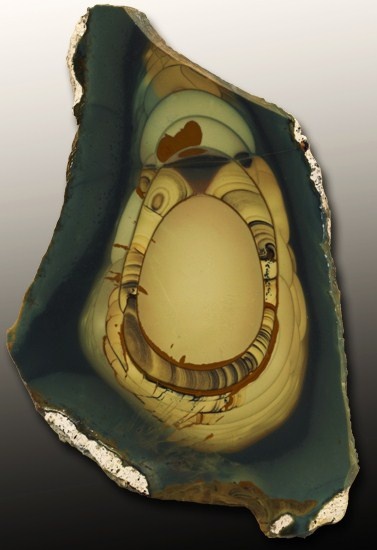
Morrisonite Jasper


Time-lapse light photography by Caleb Charland
- Atomic Model, 2008
- Helix with matchsticks, 2005
- Bouncing pen light, 2008
- Cube with Ruler and Penlight, 2007
- Fifteen Hours, 2006

The anatomy of a bubble popping! amazing!
Source: http://thatscienceguy.tumblr.com


A series of moving explorations using magnetized liquid and suspended metals. via


(by Oussama Ouassit)
Source: http://qanafir.tumblr.com