an animated map of global wind conditions
I’m a sucker for those #spirals. #drawing #art #magnetism

I’m a sucker for those #spirals. #drawing #art #magnetism

When paper #porcelain meets #magnetic inspiration. #art #ceramics
an animated map of global wind conditions

Cold weather can create some wild fluid dynamics, so pay attention to your local rivers and waterfalls during the next cold snap. The video above comes from North Dakota where a combination of cold dense air and a stable river eddy created a spinning ice disk, roughly 16 meters in diameter. The disk forms as a collection of ice chunks—not one solid, spinning piece—because the ice formed gradually. As ice pieces form, they get caught in the river eddy and begin to spin as part of the disk, rather like dust and ice do in the rings of Saturn. Such formations are rare but not unheard of; here’s a video showing a similar disk as it grows. (Video credit: G. Loegering; via Yahoo and io9; submitted by Simon H and John C)

Good luck to all the AP Physics C: E&M test takers
Compressed, by Kim Pimmel…Follow this magnetized fluid through the capillaries of bubbles. Science and art, together, in a trippy video.
“I combined everyday soap bubbles with exotic ferrofluid liquid to create an eerie tale, using macro lenses and time lapse techniques. Black ferrofluid and dye race through bubble structures, drawn through by the invisible forces of capillary action and magnetism”
![ald0us:
[sheer magnetism]](https://images.squarespace-cdn.com/content/v1/555f7100e4b0ddd6981ec806/1437142226253-NXEI1CQBWPDXMSCO1Q0A/image-asset.jpeg)
[sheer magnetism]
Diamagnetic Levitation 2 - Bismuth (by PaulsLab)
The first shot shows the setup of this experiment. One big cylindrical magnet, made from neodymium (NdFeB), is hung at the top, above two plates of bismuth. Bismuth is element nr. 83; a highly diamagnetic metal. Diamagnetic means that it creates an opposing magnetic field if there is a magnetic field close to it. That means that it will repel a magnet. The small cube between the two plates of bismuth is also made of neodymium (NdFeB) and measures 5x5x5 mm. The two plates of bismuth repel the magnet, but they are not strong enough to overcome gravity. This is solved by the big cylindrical magnet on top of it all attracting the small magnet. If all elements are aligned carefully, the small magnet will float stably between the two bismuth plates. You can easily push the magnet and it will go back to the center. It can spin for hours!

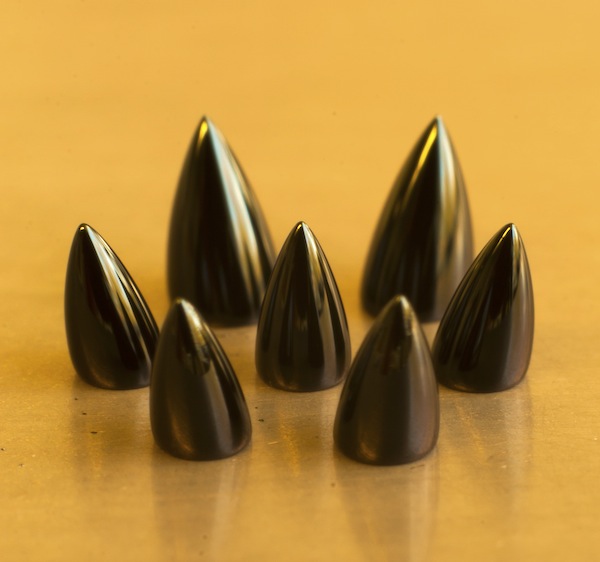


Self-Assembling Liquid Structures
by Txchnologist Staff
Researchers put liquids that become magnetized in the presence of magnetic fields on a water-repelling surface to make these small self-assembling structures.
A team from Aalto University in Finland first put a stationary magnet under the puddle of the liquid, called a ferrofluid, to create simple structures on the hydrophobic surface. Then they started moving the magnet around, the changing magnetic fields causing the more complex structures seen above to form.
Levitating Superconductor on a Mobius Strip
