The breakup of impinging jets into droplets (also called atomization) and the subsequent dynamics of those droplets are important in applications like jet and rocket engines where the mixing of liquid fuel with oxygen is necessary for efficient combustion. This video showcases recent efforts in high fidelity numerical simulation and modeling of such flows. The complexity of the problem requires clever ways of reducing the computational efforts required. One such method uses adaptive meshing to concentrate grid points in areas where variables are changing quickly while leaving the grid sparse in areas of less interest. Because the flow is constantly evolving, the mesh must be able to adapt as the simulation steps forward in time. Even so, such calculations typically require supercomputers to complete. (Video credit: X. Chen et al)
cwnl:
Isaac Newton’s Personal Notebooks Go Digital
Who says you can’t hoard anything in this now technological world? Here’s something for the science history buffs:
The largest collection of Isaac Newton’s papers has gone digital, committing to open-access posterity the works of one of history’s greatest scientist.
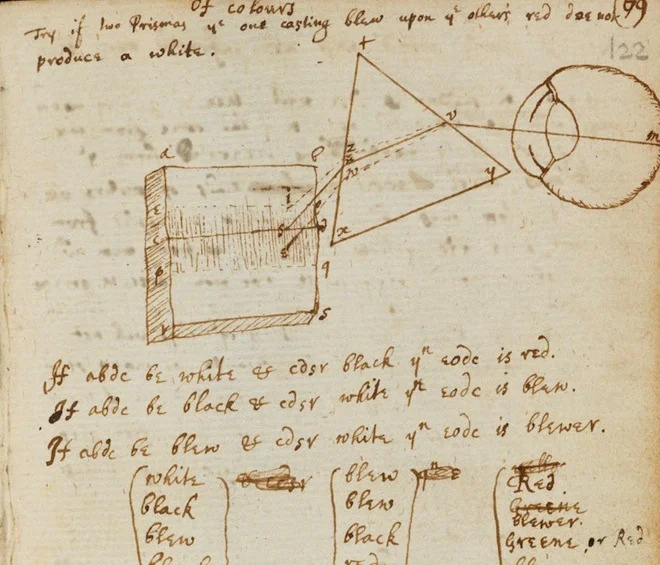
Among the works shared online by the Cambridge Digital Library are Newton’s own annotated copy of Principia Mathematica and the ‘Waste Book,’ the notebook in which a young Newton worked out the principles of calculus.
Other of his myriad accomplishments include the laws of gravity and motion, a theory of light — pictured above are notes on optics — and his construction of the first reflecting telescope.
Newton was also notoriously idiosyncratic and irascible, obsessed with the occult and vicious towards scientific rivals; a full account of his life and science can be found in James Gleick’s Isaac Newton, and a partial but entertaining fictionalization in Neal Stephenson’s Baroque Cycle. But the papers come straight from the master.
“Anyone, wherever they are, can see at the click of a mouse how Newton worked and how he went about developing his theories and experiments,” said Grant Young, the library’s digitization manager, in a press release. “Before today, anyone who wanted to see these things had to come to Cambridge. Now we’re bringing Cambridge University Library to the world.”
Approximately 4,000 pages of material are available now, and thousands more will be uploaded in coming months.
evidently Robbie Rowlands likes to cut things ;)
cwnl:
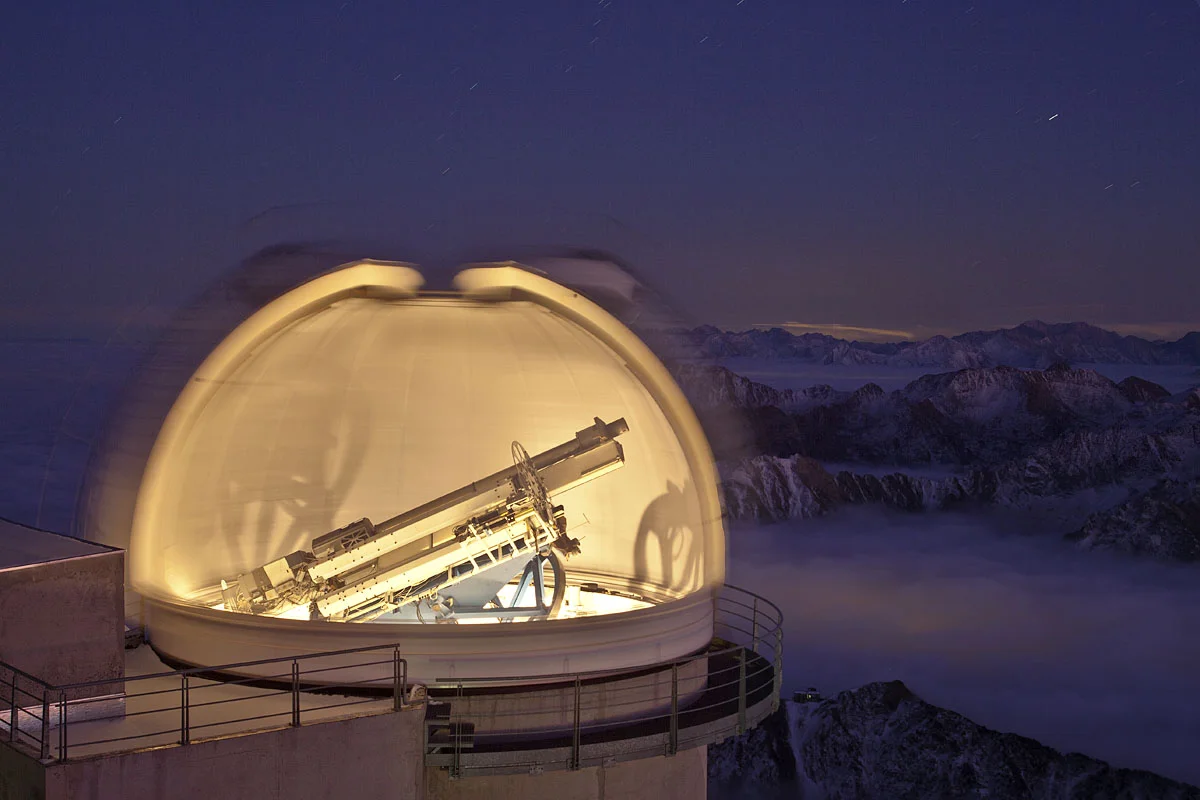
Rotation Dome of CLIMSO
The Christian Latouche IMageur Solaire (CLIMSO), is an observatory stationed at Pic-du-Midi museum of France. CLIMSO is an astronomical observation instrument specialized in the study of the Sun. It makes multiple films of the sun , particularly the globality of the surface and crown. In the image above it was captured in exposure as it rotated putting on a beautiful show against the backdrop of the night sky.
Copyright: Alain Sallez
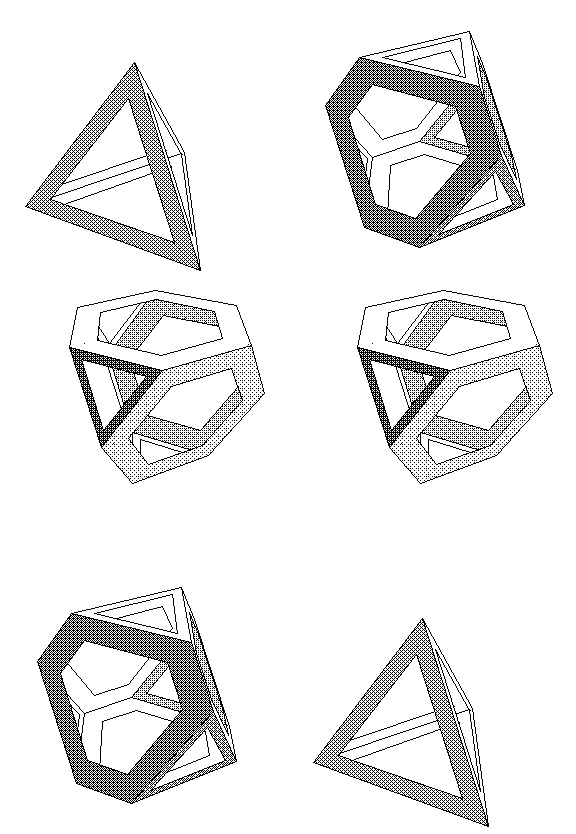
This truncation shows that the dual polyhedron of the tetrahedron is itself.
More here.(via ultrazapping)
Holy shit… so awesome.
hubba hubba
High-Res (750x750)
Mathematica code:
Animate[
Graphics[
Table[
Circle[{10*Cos[i*Pi/10], 10*Sin[i*Pi/10]},
t + (20 - n) (1 + Sign[20 - n])/2],
{n, 0, 100, 1}, {i, 0, 19, 1}],
PlotRange -> 15, ImageSize -> 750],
{t, 0, 1, .1}]
Black Water.. what a concept. This packaging that ‘changes’ when empty is a great move. Albeit you only get to enjoy this twist AFTER you have purchased and used the product - so is it really effective marketing?
cwnl:
We’ve seen them in our most beloved sci-fi movies (Contact anyone?) and series (Star Trek, Dr. Who), we’ve heard physicists, astrophysicists and astronomers speak of it with great enthusiasm and interest. But what exactly are these cosmic phenomena?
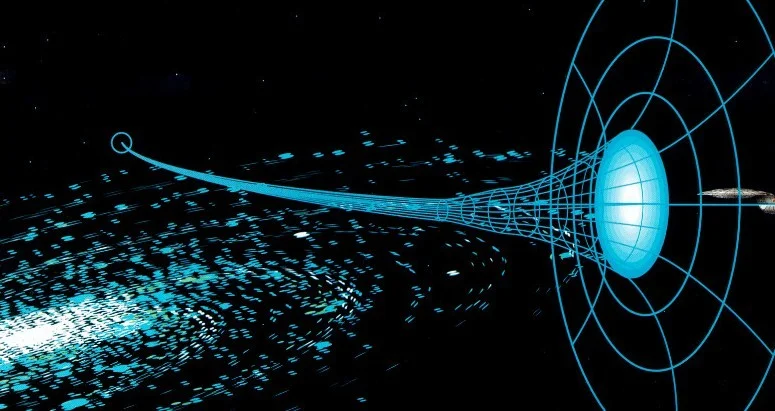
Wormholes are solutions to the Einstein field equations for gravity that act as “tunnels,” connecting points in space-time in such a way that the trip between the points through the wormhole could take much less time than the trip through normal space.
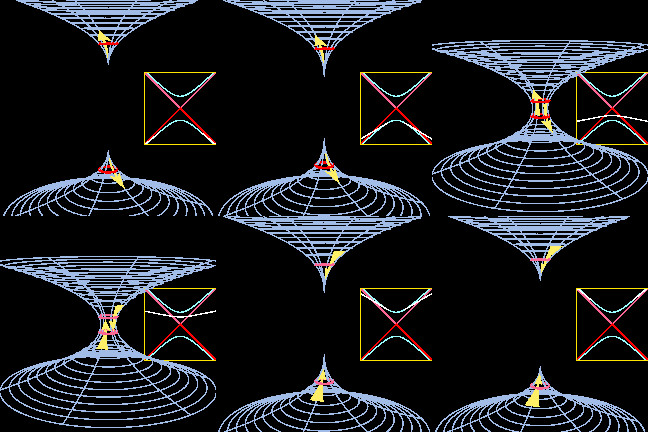
The first wormhole-like solutions were found by studying the mathematical solution for black holes. There it was found that the solution lent itself to an extension whose geometric interpretation was that of two copies of the black hole geometry connected by a “throat” (known as an Einstein-Rosen bridge). The throat is a dynamical object attached to the two holes that pinches off extremely quickly into a narrow link between them.
Theorists have since found other wormhole solutions; these solutions connect various types of geometry on either mouth of the wormhole. One amazing aspect of wormholes is that because they can behave as “shortcuts” in space-time, they must allow for backwards time travel! This property goes back to the usual statement that if one could travel faster than light, that would imply that we could communicate with the past.
Wormhole geometries are inherently unstable. The only material that can be used to stabilize them against pinching off is material having negative energy density, at least in some reference frame. No classical matter can do this, but it is possible that quantum fluctuations in various fields might be able to.